Large Scaly Patch on Your Teen’s Skin? Causes, Treatment, and When to Worry
Large Scaly Patch on Your Teen’s Skin? Causes, Treatment, and When to Worry
Discovering an unusual skin change on your teenager—especially a large, scaly patch that seems to appear out of nowhere—can be concerning. It’s natural for any parent or caregiver to feel uneasy when something unfamiliar shows up on their child’s body, particularly if more spots begin to develop over time. Questions tend to arise quickly: What is it? Is it serious? Could it spread to others in the household? And perhaps most frustrating of all, what should you do if you can’t immediately get a medical appointment?
Situations like this can feel overwhelming, but gaining a clearer understanding of common skin conditions can help ease some of that anxiety. Many rashes look similar at first glance, and not all of them signal something dangerous. One possible explanation for a large, scaly patch followed by smaller spots is a condition known as pityriasis rosea. While the name may sound unfamiliar, it is actually a relatively common and generally harmless skin condition, especially among teenagers and young adults.
This article takes a closer look at what might be causing such a rash, focusing in particular on pityriasis rosea. It also offers practical advice on how to manage symptoms, monitor changes, and support your teenager both physically and emotionally while waiting to consult a healthcare professional.
Skin conditions can be tricky to identify because they often share similar features—redness, scaling, itching, or patchy appearances. Without medical training, it’s easy to confuse one condition for another. However, learning to recognize general patterns and understanding the typical progression of certain rashes can make a big difference. Not only can this knowledge help reduce worry, but it can also guide you in taking appropriate steps at home until professional care becomes available.
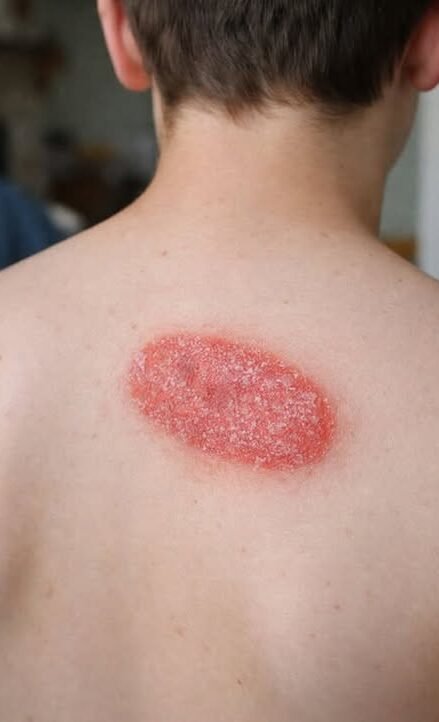
One of the more common explanations for a single, large scaly patch is pityriasis rosea. This condition often begins with what is called a “herald patch.” As the name suggests, this patch acts as a signal or precursor to the rest of the rash. It is usually the first visible sign and tends to be larger than any spots that follow. The herald patch typically measures anywhere from about 2 to 10 centimeters in diameter and is often found on the back, chest, or abdomen.
In appearance, the herald patch is usually oval or round. It may be pink or reddish in color, with a slightly raised border and a scaly texture. Some people describe it as looking similar to ringworm at first glance, which can lead to confusion. However, unlike fungal infections, pityriasis rosea follows a different pattern as it progresses.
After the herald patch appears, additional smaller spots often begin to develop. This usually happens within a few days to two weeks. These secondary patches are generally much smaller, typically ranging from about half a centimeter to two centimeters wide. They often spread across the torso and sometimes extend to the upper arms or thighs.
One of the most distinctive features of pityriasis rosea is the pattern these smaller spots tend to form. They often align along the natural lines of the skin, creating a distribution that resembles the branches of a Christmas tree. This pattern is especially noticeable on the back and can be a helpful clue in identifying the condition.
Although the rash may look alarming, pityriasis rosea is generally mild. It is not usually painful, though some individuals experience mild to moderate itching. The level of discomfort can vary from person to person. For some teenagers, the itchiness is barely noticeable, while for others it may be more bothersome, particularly in warm conditions or after sweating.
One of the most reassuring aspects of pityriasis rosea is that it is not considered contagious. It does not spread through direct skin contact, sharing clothing, or being in close proximity to others. This means there is no need to isolate your teenager from family members, friends, or school activities solely because of the rash.
The exact cause of pityriasis rosea is not fully understood, but many experts believe it may be triggered by a viral infection. Certain types of viruses—possibly related to common herpesviruses—have been suggested as potential contributors. However, it’s important to note that this condition does not behave like highly contagious viral illnesses such as the flu or the common cold.
In most cases, pityriasis rosea resolves on its own without the need for aggressive treatment. The entire course of the condition typically lasts between six and eight weeks, although in some cases it may persist for up to three months. The herald patch appears first, followed by the smaller spots within one to two weeks. After several weeks, the rash gradually begins to fade, often starting from the center of the patches outward.
Even though the condition is self-limiting, it’s still important to monitor your teenager’s symptoms. If the rash behaves differently than expected—for example, if it spreads rapidly, becomes very painful, or is accompanied by other symptoms such as fever, sore throat, or extreme fatigue—it’s wise to seek medical advice. These additional signs could indicate a different underlying issue that requires further evaluation.
It’s also worth being aware that several other skin conditions can look similar to pityriasis rosea. For instance, ringworm (also known as tinea corporis) is a fungal infection that produces circular, scaly patches with a clearer center. Unlike pityriasis rosea, ringworm is contagious and typically requires antifungal treatment.
Eczema is another possibility. This condition often presents as dry, itchy patches that can appear anywhere on the body. It tends to be chronic or recurring and may improve with regular moisturizing and avoidance of irritants.
Psoriasis is another condition that can resemble pityriasis rosea in some cases. It usually appears as thick, red plaques with silvery scales and commonly affects areas such as the elbows, knees, and scalp. Psoriasis often requires ongoing management and may involve prescription treatments.
Because these conditions can overlap in appearance, careful observation is key. Pay attention to how the rash develops over time. Does it follow a recognizable pattern? Are new spots appearing in a predictable way? Are there other symptoms present? Taking clear photos every few days can be extremely helpful, especially if you plan to consult a healthcare provider later. These images allow professionals to see how the rash has evolved, which can aid in diagnosis.
While waiting for a medical appointment, there are several steps you can take to help your teenager feel more comfortable. If itching is a concern, over-the-counter antihistamines such as loratadine or diphenhydramine may provide some relief. Topical treatments like calamine lotion or mild hydrocortisone cream can also help soothe irritated skin.
Encouraging your teenager to wear loose-fitting, breathable clothing—preferably made of cotton—can reduce irritation. Tight or rough fabrics may worsen itching or cause additional discomfort. Keeping the skin cool and avoiding excessive heat or sweating can also make a difference, as warmth tends to intensify itching in many skin conditions.
In addition to physical symptoms, it’s important to consider the emotional impact of a visible skin condition. Teenagers are often particularly sensitive about their appearance, and a noticeable rash can affect their confidence or self-esteem. They may feel embarrassed, anxious, or reluctant to participate in social activities.
Approach conversations with understanding and empathy. Let your teenager know that their feelings are valid and that it’s okay to be concerned or self-conscious. At the same time, reassure them that conditions like pityriasis rosea are common and temporary. Emphasize that the rash does not define who they are and that it will gradually improve.
Open communication is key. Encourage your teenager to share how they’re feeling, both physically and emotionally. If they’re worried about how others might react, discuss ways to handle questions or comments from peers. Sometimes simply knowing they have your support can make a significant difference.
If access to a healthcare provider is delayed, there are alternative options to consider. Telehealth services have become increasingly available and can offer convenient access to medical advice from home. Many platforms allow you to upload photos of the rash, enabling dermatology professionals to provide preliminary assessments.
Community health clinics, urgent care centers, and pharmacy-based walk-in clinics may also be able to evaluate the rash without requiring a formal referral. While these options may not replace a full dermatology consultation, they can provide guidance and peace of mind in the meantime.
When you do see a healthcare provider, they will typically begin with a visual examination of the rash and a review of your teenager’s medical history. In many cases, pityriasis rosea can be diagnosed based on appearance alone. However, if there is any uncertainty, additional tests may be performed. These could include a skin scraping to rule out fungal infections or, in rare cases, a biopsy to examine the skin more closely.
Treatment for pityriasis rosea is generally focused on relieving symptoms rather than curing the condition, since it resolves on its own. In more severe cases—such as when itching is intense or the rash persists longer than expected—doctors may recommend prescription medications or other therapies to help speed recovery and reduce discomfort.
Ultimately, while discovering a sudden skin change can be unsettling, it’s important to remember that many rashes in teenagers are temporary and manageable. Pityriasis rosea, in particular, is a condition that often looks more alarming than it actually is. With time, patience, and supportive care, it typically fades without leaving lasting effects.
Staying informed, keeping track of symptoms, and maintaining open communication with your teenager can make this experience far less stressful. Even if you’re waiting for a medical appointment, there are meaningful steps you can take to provide comfort and reassurance. And in most cases, what initially feels like a worrying mystery turns out to be a harmless condition that simply needs time to run its course.