House Centipedes Explained: Identification, Behavior, and How to Get Rid of Them
A sudden encounter with a strange, fast-moving, many-legged creature racing across a cold basement floor can easily unsettle even the calmest homeowner. In low light, the insect’s movement appears almost unreal—quick, erratic, and surprisingly coordinated. Its elongated body, combined with an excessive number of legs and extremely long antennae, often gives it an almost prehistoric or “out of place” appearance, as though it belongs more in a science fiction setting than inside a modern home.
For many people, the immediate reaction is a mix of shock and discomfort. It is common to feel startled or even alarmed, especially when the creature disappears just as quickly as it appears. This moment often triggers a wave of questions: What is it? Can it harm people or pets? Why is it inside the house at all? And perhaps most importantly, does its presence indicate a larger problem within the home environment?
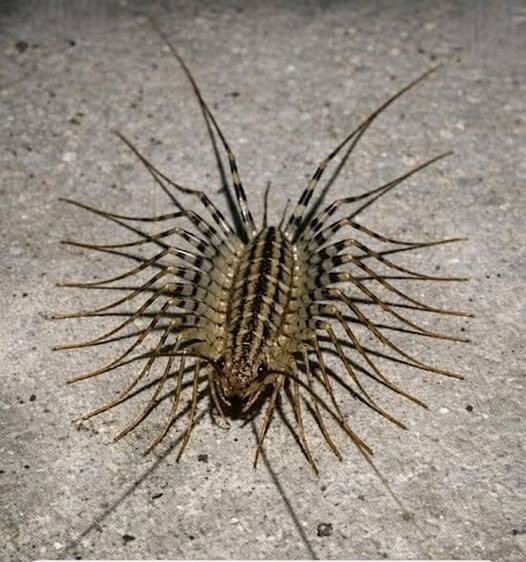
In most cases, the mysterious intruder is a house centipede, scientifically identified as Scutigera coleoptrata. Despite its intimidating appearance, this arthropod is far more misunderstood than dangerous. It is a naturally occurring species that has adapted exceptionally well to indoor environments, particularly in human dwellings where conditions mimic the damp, sheltered spaces it prefers in nature.
A closer look reveals several defining characteristics. The house centipede typically has a yellowish to grayish body, often marked with darker stripes running lengthwise along its back. Adults usually measure up to about one and a half inches in body length, but its appearance is greatly exaggerated by its extremely long legs. In fact, it has fifteen pairs of legs—thirty in total—which extend well beyond its body and create a delicate, almost feathery outline when in motion. Adding to its unusual look are its elongated antennae, which are often as long as or even longer than the body itself. These features combine to create an insect that appears both delicate and unsettling at the same time.
Although its appearance can be alarming, much of the fear surrounding house centipedes comes from misunderstanding rather than actual risk. Their body structure is specifically designed for speed and survival in dark, enclosed environments. Unlike many slow-moving household insects, the house centipede is an exceptionally agile predator. Its legs move in a synchronized wave-like pattern, allowing it to accelerate rapidly and change direction almost instantly. This makes it one of the fastest arthropods commonly found indoors, capable of moving more than a foot per second in short bursts.
This speed is not just for show—it is a key survival mechanism. House centipedes rely on quick movement to capture prey and avoid larger threats. Their long antennae are highly sensitive sensory tools that help them detect vibrations, air movement, and chemical signals in the environment. Even in complete darkness, they can effectively navigate complex spaces such as cracks in walls, plumbing gaps, and cluttered storage areas. While this level of sensory adaptation can make them seem almost alien, it is simply a highly efficient biological design shaped by evolution.
Despite their somewhat frightening appearance, house centipedes are not considered dangerous to humans or pets. They do possess venom, but it is important to understand its purpose and limitations. The venom is specifically adapted for subduing small insects such as flies, ants, spiders, and cockroaches. It is not biologically designed to affect larger animals like humans or domestic pets in any significant way.
Their mouthparts are also relatively weak. In most situations, they are unable to penetrate human skin. On the rare occasion that a bite does occur—typically only if the insect is handled or threatened directly—the reaction is usually mild. Most people report a slight pinching sensation, followed by minor redness or localized irritation that fades quickly without medical treatment. Serious reactions are extremely uncommon.
Concerns about pets are similarly minimal. Cats and dogs may occasionally notice or interact with a centipede, but the insect’s instinctive response is to flee rather than fight. House centipedes are not aggressive hunters of large animals and prefer to retreat into narrow hiding places when disturbed. As a result, incidents involving bites on pets are rare to the point of being almost negligible in typical household environments. Nevertheless, basic caution is always sensible when pets are exploring basements, bathrooms, or other areas where small wildlife may be present.
While many people are relieved to learn that house centipedes are not dangerous, there is another surprising aspect of their existence that often changes how they are perceived: they are beneficial predators within the home ecosystem. Far from being harmful invaders, they actually play the role of natural pest controllers.
Their diet consists of a wide range of unwanted household insects. This includes common nuisances such as cockroaches, termites, ants, silverfish, spiders, and even certain types of bed bugs. Because of this, house centipedes can actually help reduce populations of more problematic pests that are far more destructive or difficult to manage. In many cases, their presence indicates that they are actively hunting other insects that may otherwise go unnoticed.
In a way, house centipedes function as an unintentional form of biological pest management. They quietly move through dark corners, behind furniture, and along basement walls, seeking out small insects to feed on. While their appearance may be unsettling, their role in controlling pest populations can actually contribute to a more balanced indoor environment.
Understanding why house centipedes enter homes in the first place is essential for managing their presence effectively. These creatures are not randomly wandering indoors; they are responding to environmental conditions that closely match their survival needs. Three primary factors tend to attract them: moisture, shelter, and food availability.
Basements, crawl spaces, bathrooms, and laundry rooms often provide ideal conditions. These areas tend to be darker, cooler, and more humid than the rest of the home. Moisture is especially important because house centipedes are highly sensitive to dehydration. Their bodies are not well adapted to dry environments, so they naturally gravitate toward damp spaces where humidity levels help them survive.
Darkness is another key factor. In nature, house centipedes typically live under rocks, logs, and leaf litter, where sunlight is minimal. Indoor environments that replicate these conditions—such as cluttered storage areas or rarely used basements—become attractive hiding and hunting grounds.
The third factor is food supply. Where there are house centipedes, there are usually smaller insects nearby. If a home has an existing population of pests such as ants, silverfish, or cockroaches, it creates a reliable food source that encourages centipedes to remain in the area. In this sense, their presence can sometimes indicate a broader pest issue that may need attention.
For individuals who are uncomfortable sharing their home with these fast-moving creatures, removal can be done safely and without the use of harsh chemicals. One of the simplest and most humane methods is the cup-and-card technique. This approach involves gently placing a container over the centipede, sliding a stiff piece of paper or cardboard underneath to trap it, and then transporting it outside.
This method is effective because it avoids direct contact and minimizes stress for both the person and the insect. Once released outdoors, preferably in a shaded and moist area such as a garden bed, the centipede can continue its natural role in the ecosystem without returning indoors.
Preventing future encounters requires a focus on environmental management rather than elimination alone. Since house centipedes are drawn to moisture and food sources, reducing these conditions inside the home can significantly decrease their presence.
One of the most effective strategies is moisture control. Using dehumidifiers in basements, improving ventilation in bathrooms, and addressing any leaks or water accumulation can make indoor environments less suitable for them. Dry conditions are far less attractive to centipedes and their prey.
Sealing entry points is another important step. Small cracks in walls, gaps around plumbing, and openings near windows or doors can all serve as entryways. Proper sealing helps block access and reduces the likelihood of insects entering from outside environments.
Cleanliness and organization also play a major role. Regular vacuuming, reducing clutter, and maintaining organized storage areas limit hiding spots for both centipedes and the insects they feed on. When potential shelter and food sources are minimized, the home becomes significantly less appealing to them.
In summary, the presence of a house centipede inside a home can be startling, but it is rarely a cause for concern. These creatures are not dangerous in any meaningful way to humans or pets, and they actually provide a useful ecological function by helping control other household pests. Their unusual appearance and rapid movements often contribute to fear, but their behavior is primarily defensive and non-aggressive.
By understanding their biology and behavior, homeowners can shift from fear to informed awareness. Rather than viewing them solely as unwanted intruders, it becomes easier to recognize the environmental conditions that attract them and to take simple, effective steps to reduce their presence. Through moisture control, sealing entry points, and maintaining clean, organized spaces, it is entirely possible to create a living environment that is less inviting to house centipedes while still supporting a healthy indoor balance.
Ultimately, encountering a house centipede is more of a reminder about the hidden ecosystems that exist within and around human homes than it is a sign of danger. With the right knowledge and preventative measures, these fast-moving basement visitors can be managed calmly, safely, and effectively.